
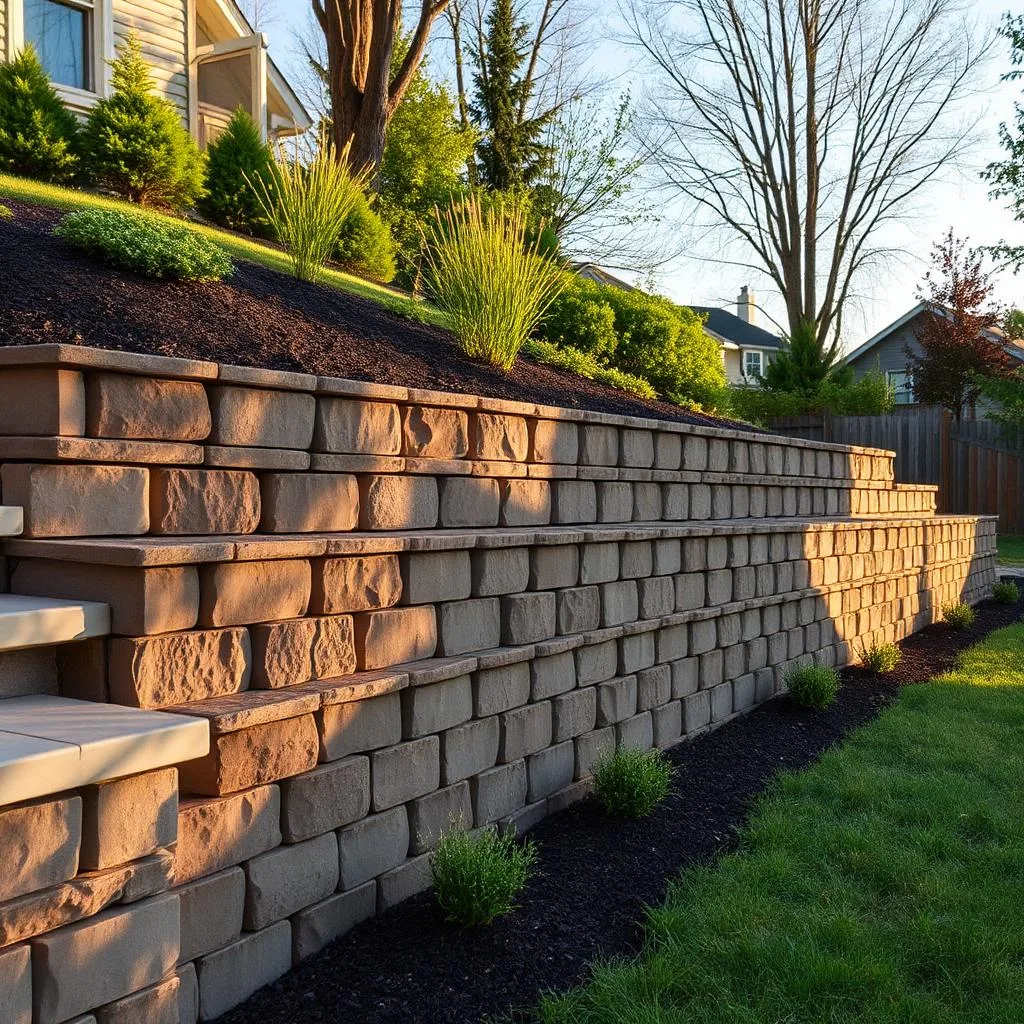
Short answer: most retaining walls we build in Oakland County land between about $35 and $65 per square foot of wall face, installed. A wall 30 feet long and 3 feet tall has 90 square feet of face, so it usually runs somewhere between $3,150 and $5,850. Taller walls, natural stone, and walls that need an engineer cost more. Here is what moves the number, and what a low bid usually leaves out.
How retaining walls are priced
Contractors price walls by the square foot of wall face, which is the length times the height. Some quote by the linear foot instead, which hides how tall the wall is. Ask for square feet so you can compare bids fairly. Also ask whether the height includes the buried courses. In Michigan, part of every wall sits below grade, and that part costs money to build even though you never see it.
For context, national cost guides like LawnStarter put most retaining walls between $20 and $53 per square foot. Our range runs higher than the national middle for one reason: we build for Oakland County clay and a 42-inch frost line, with drainage and reinforcement on every wall that needs it. A wall built to the national average is often a wall built without those things.
What drives the price of a retaining wall
- —Height. This is the biggest one. A 2-foot garden wall is simple. Past 4 feet, measured from the bottom of the footing, Michigan generally requires an engineered design and a permit. Taller walls also need more geogrid, more excavation, and more stone behind them.
- —Material. Segmental concrete block from Unilock, Belgard, or Versa-Lok is the most common and cost-effective choice. Natural stone and boulder walls cost more and take longer to set.
- —Drainage. Every wall we build gets perforated drain tile and a clean-stone chimney behind it. That stone is a real share of the material cost, and it is the part that keeps the wall standing.
- —Reinforcement. Taller walls need geogrid, a mesh laid between courses and run back into the hill. More grid means more digging, more backfill, and more compaction.
- —Access. A backyard behind a narrow gate, or a lake lot where equipment has to come down a slope, takes more labor than an open front yard.
- —What sits above the wall. A wall holding up a driveway, a patio, or a steep slope carries more load than one holding back flat lawn. That extra load usually means engineering.
- —Removal. Tearing out an old timber or failed block wall, and hauling it away, adds to the job.
Sample retaining wall budgets in Oakland County
Every lot is different, so treat these as ballpark numbers, not quotes.
- —A low garden or planter wall, about 2 feet tall and 25 feet long (50 square feet of face): roughly $1,750 to $3,250.
- —A backyard wall that levels out a patio area, about 3 feet tall and 40 feet long (120 square feet): roughly $4,200 to $7,800.
- —A taller wall on a sloped lot in Clarkston, Northville, or White Lake, 4 to 5 feet tall and 50 feet long: often $9,000 to $16,000 or more once engineering and the permit are included.
- —A terraced set of two or three shorter walls on a walkout lot: priced as separate walls, plus the steps and planting between them.
Those numbers depend heavily on the soil and the water. A wall on dry, sandy ground is a different job from one on wet clay at the bottom of a hill. That is why we walk the site before we put a price on paper.
What a cheap retaining wall bid usually leaves out
When one bid comes in far below the others, the missing money is almost always below the surface. Here is what to look for in every quote:
- —Base depth and compaction. The base should be compacted gravel set deep enough for the wall's height. A wall sitting on a few inches of sand in the top foot of soil will move with the frost.
- —Drain tile. Perforated pipe at the base of the wall, with an outlet, so water has a way out.
- —Clean stone behind the wall. A column of washed stone behind the block lets water drain down to the pipe instead of building pressure.
- —Geogrid. On walls over a couple of feet, ask where the grid goes and how far back it runs.
- —Engineering and permit. If the wall is over 4 feet from the bottom of the footing, or holding up a driveway or structure, the bid should include both.
If a quote does not mention these, ask. If the answer is vague, the wall will be too. We replace a lot of walls that were built cheap. Almost all of them failed for the same reasons: no drainage and no reinforcement.
Why Oakland County walls cost more to build right
Most of the county sits on heavy glacial clay. Clay holds water, gets heavy when wet, and pushes hard against anything holding it back. Add 30 to 40 freeze-thaw cycles a winter and a frost line around 42 inches, and you have the two forces that destroy retaining walls: water pressure and frost heave.
The fix is not complicated, but it is not free. Dig deeper. Compact the base in layers. Put drain tile and clean stone behind every course. Tie taller walls into the hillside with geogrid. That is the work that separates a wall that holds the hill in February from one that bulges by spring.
Block or natural stone?
Segmental block is engineered for retaining walls. It comes with tested reinforcement charts, stacks consistently, and costs less to install. Natural stone and boulder walls have a one-of-a-kind look that fits wooded lots and lake properties, and they cost more because every stone is set by hand. Both can be built to last. We match the system to the height, the load, and the look you want.
Can you save money on a retaining wall?
Sometimes, yes. A few honest ways:
- —Terrace instead of one tall wall. Two walls under 4 feet can cost less than one tall engineered wall and give you more usable flat space.
- —Regrade where you can. On a gentle slope, reshaping the ground and planting it may do the job with a shorter wall, or no wall.
- —Build it with the patio. If you are also planning a patio or steps, doing the work together saves a second round of excavation and equipment.
The one place not to save is drainage. A wall without it is the most expensive wall you can build, because you will build it twice.
Get a real number for your wall
Michigan Outdoor Creations builds retaining walls across Walled Lake, Commerce, Milford, Clarkston, Northville, and the rest of Oakland County. Every wall goes on a compacted base below frost, with drain tile and clean stone behind it and geogrid where the height calls for it. We will walk your slope, tell you whether it needs a permit, and give you a fixed written price.
Call 248-916-6012 or request a free on-site estimate.
Common questions
How much does a retaining wall cost per square foot in Oakland County?
Most retaining walls Michigan Outdoor Creations builds run about $35 to $65 per square foot of wall face, installed. Taller engineered walls and natural stone run higher.
How much does a 3-foot retaining wall cost?
A 3-foot wall that is 40 feet long has 120 square feet of face, so it usually lands around $4,200 to $7,800, depending on material, access, and drainage needs.
Do I need a permit for a retaining wall in Oakland County?
Walls over about 4 feet, measured from the bottom of the footing, or walls holding up a driveway or structure, generally need an engineered design and a permit.
Why are some retaining wall bids so much cheaper?
Usually because they leave out drainage, geogrid, or base depth. Those are the parts that keep a wall standing through Michigan winters.
Is a block or stone retaining wall cheaper?
Segmental block is usually less expensive to install than natural stone or boulder walls, and it comes with engineered reinforcement charts.