
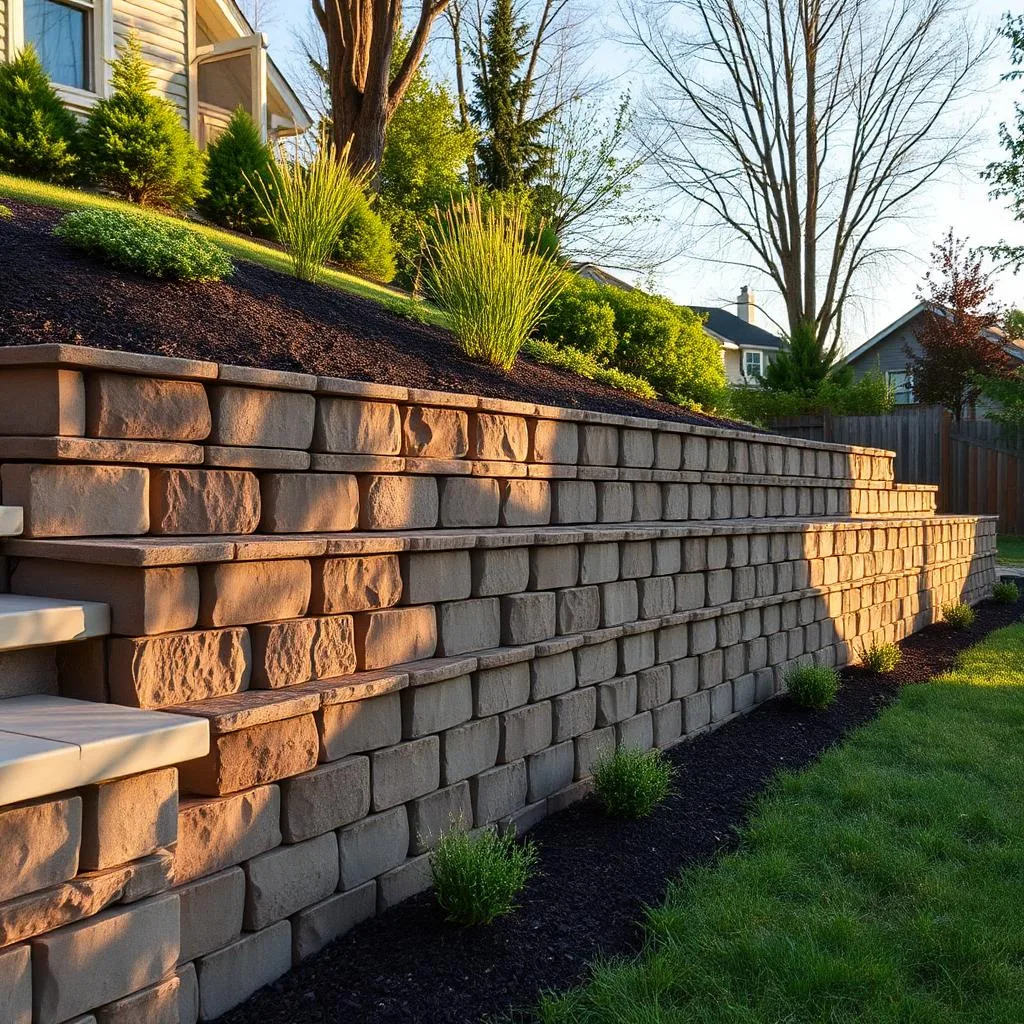
A retaining wall does not lean for no reason. When we get called to look at a wall in Clarkston or Waterford that has started to bow out at the middle or tip forward at the top, the cause is almost always one of three things, and it is almost always hiding behind the wall where nobody can see it. Here is how to read what your wall is telling you.
Cause one: water with nowhere to go
This is the big one. Oakland County clay holds water. When rain and snowmelt soak into the soil behind a wall and cannot drain out, that water builds hydrostatic pressure, and pressure pushes. A wall built without perforated drain tile at the base and clean stone behind it is holding back wet clay that gets heavier and pushier every spring. The classic sign is a bulge in the middle of the wall, often with damp staining on the face or water weeping out between blocks after a storm.
Cause two: nothing tying the wall into the hill
Segmental block walls above a couple of feet need geogrid, a mesh reinforcement laid between courses and extended back into the slope. The grid turns the soil behind the wall into part of the wall. Without it, the blocks are just stacked in front of a hill that wants to slide. The sign here is a wall that leans forward from the top, sometimes with the top courses sliding out ahead of the ones below.
Cause three: a shallow base and frost
Michigan's frost line runs to about 42 inches. A wall whose base sits in the top foot of soil rides up and down with every freeze-thaw cycle, and there are 30 to 40 of those a winter. The blocks shift a little each time. The sign is a wall that has gone wavy along its length, with courses that no longer line up and gaps opening at the joints.
Other signs to look for
- —Cracks in a poured or mortared wall, especially stair-step cracks in block, point to movement below the wall.
- —Soil or mulch washing out below the wall means water is moving through, not around.
- —A patio or driveway above the wall that has started to settle or crack is the surcharge pushing down and out.
- —Timber walls that feel soft or spongy are rotting from the inside and are past saving.
Can a leaning wall be repaired?
Sometimes, if it is caught early and the lean is small. Adding drainage behind an existing wall is possible but disruptive, because the wall has to be excavated from behind. In most cases, once a wall has bulged or leaned visibly, the honest answer is to take it down and rebuild it properly on a compacted base below frost, with drain tile, a stone chimney, and geogrid. Patching the face of a failing wall is money spent on a wall that is still failing.
How we build walls that do not move
Michigan Outdoor Creations grew out of a drainage company, and a retaining wall is the clearest example of why that matters. Every wall we build gets an engineered design sized to the slope and soil, a compacted base set below the 42-inch frost line, perforated drain tile and a clean-stone drainage chimney behind every course, and geogrid tied back into the hillside where the height calls for it. The wall holds its grade and sheds its water through every freeze-thaw cycle.
Have a wall in Waterford, Clarkston, Northville, or anywhere in Oakland County that is starting to lean? We will look at it, tell you straight whether it can be saved, and give you a fixed price to build one that holds.