
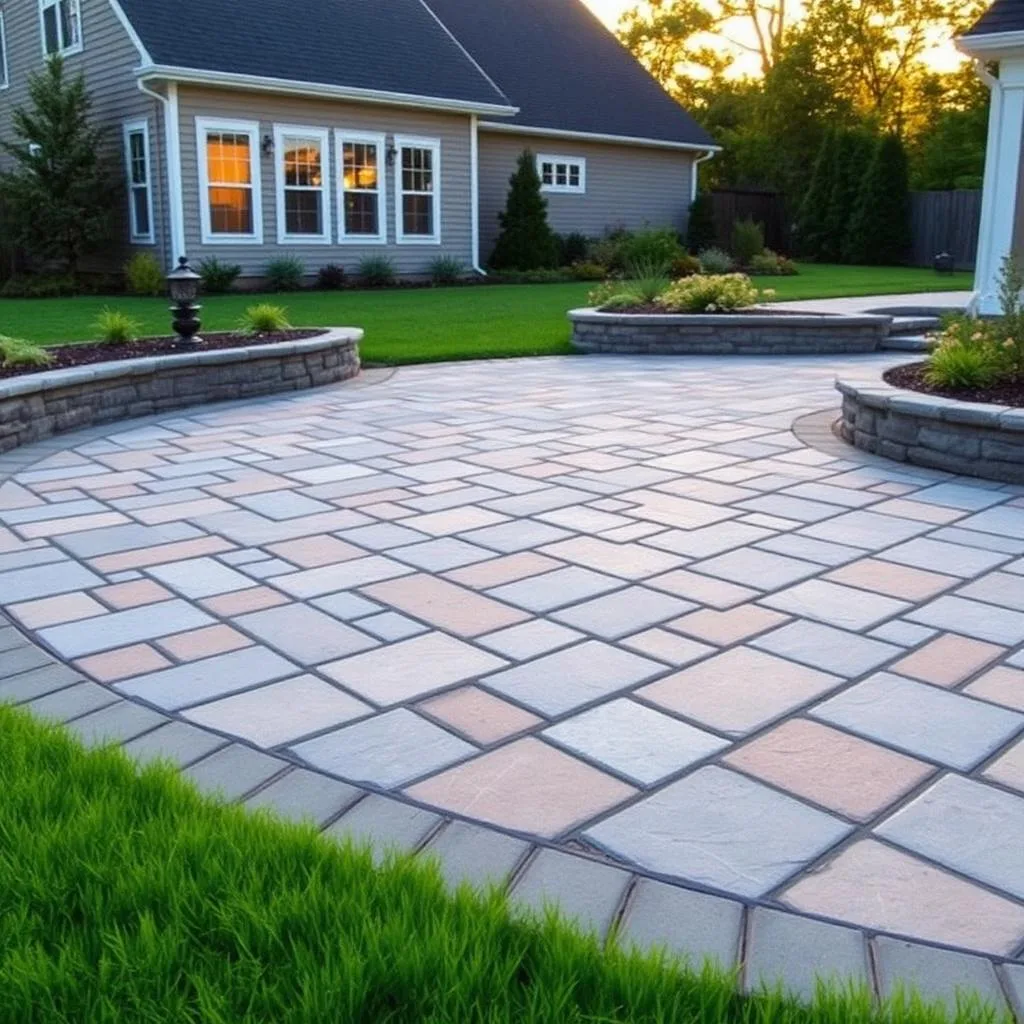
Yes, you can put a hot tub on a paver patio. Pavers set on a deep, compacted base are one of the best foundations for a hot tub, and they look a lot better than a plain concrete slab. The catch is the word "base." A filled hot tub is one of the heaviest things you will ever park in your backyard, and a patio built only for chairs and a grill is not automatically ready for it.
Here is what Michigan homeowners should know before the tub shows up on the delivery truck.
How heavy is a hot tub, really?
Heavier than most people expect. A typical four-to-six-person tub weighs several hundred pounds empty. Add a few hundred gallons of water at about 8.3 pounds per gallon, plus the people sitting in it, and the total often passes 4,000 pounds. Spread across the tub's footprint, that is roughly 100 pounds or more on every square foot. Hot tub makers publish their own numbers: Master Spas, for example, calls for a concrete base able to carry 120 pounds per square foot. Check the spec sheet for your model, because larger tubs and swim spas carry far more.
Pavers themselves are strong. A well-made concrete paver handles far more weight than a hot tub puts on it. The pavers are not the weak point. The ground under them is.
What the base under a hot tub needs
A paver patio is a layered system. The pavers sit on a thin bed of sand, which sits on compacted gravel, which sits on the soil. For a hot tub, every layer matters more than usual.
- —Deep, compacted gravel base. Manufacturers like Sundance Spas describe a typical paver pad as 4 to 6 inches of compacted gravel. On Oakland County clay we go deeper under the tub area, compacting in layers so nothing settles once the weight goes on.
- —A thin, even sand bed. About an inch of bedding sand, screeded flat. Too much sand lets pavers shift under a heavy, concentrated load.
- —Pavers rated for the load. Thicker pavers, often 2 3/8 inches or more, or a driveway-rated paver, handle the weight better than thin patio units.
- —A dead-level pad. Most patios are pitched slightly so water runs off. A hot tub needs a flat, level spot to sit on. We build the tub pad level and pitch the patio around it so water still drains away.
- —Firm edges. Edge restraint keeps the pavers under the tub from creeping outward over time.
The best time to plan for a hot tub is before the patio is built. If you think you might add one in the next few years, tell your contractor now. Building a reinforced, level pad into the patio from day one costs far less than tearing out a finished patio later.
What Michigan winters add to the problem
This is where a lot of hot tub patios go wrong here. Michigan has a frost line around 42 inches and sees 30 to 40 freeze-thaw cycles a winter. Water that sits under a patio freezes, expands, and lifts the pavers. Then it thaws and they drop back down, never quite to the same spot. That is why paver patios sink and heave, and under a hot tub, even a small amount of heave can tilt the tub, stress the shell, and open gaps under the cabinet.
Hot tubs also bring water to the patio. Splash-out, overflow, snowmelt off the cover, and the occasional drain-down all land right next to the tub. If that water soaks into the base instead of running off, it freezes there. Good drainage under and around the pad is not optional in Michigan.
- —Pitch the surrounding patio away from the tub and away from the house.
- —Keep downspouts from dumping near the pad.
- —Use polymeric joint sand so water runs over the joints instead of washing them out.
- —On wet clay lots, consider a drainage stone layer or drain tile under the pad to give water a way out.
Pavers or a concrete pad?
Both work. Here is how to choose.
Pavers look better, blend into the rest of the patio, and flex slightly with the ground instead of cracking. If one section settles, the pavers can be lifted and reset. The tradeoff is that the base has to be built carefully, because pavers will show settling that a slab might hide for a while.
A concrete pad is rigid and spreads the load evenly, which is why many manufacturers list it first. It is a good choice for very large tubs and swim spas. The tradeoffs are looks and permanence. A gray slab in the middle of a paver patio stands out, and if you remove the tub someday, the slab stays. One common solution is a reinforced concrete pad under the tub with pavers around it, or pavers laid over a concrete slab. Our pavers vs. stamped concrete guide covers the bigger picture, and we help you weigh the options for your tub, your lot, and your budget.
Can you put a hot tub on an existing patio?
Sometimes. If your patio was built on a deep, well-compacted base, is in good shape, and has a spot that can be made level, it may handle a tub just fine. Warning signs that it cannot:
- —The patio already has dips, sunken edges, or heaved corners.
- —Water pools on it after a rain.
- —Weeds grow in the joints, which usually means plain sand and a loose surface.
- —You do not know how deep the base is, and the patio was a quick install.
In those cases, the safest move is to rebuild the base under the tub area before the tub goes on. Pavers can usually be lifted, the base rebuilt and compacted, and the same pavers relaid.
Other things to plan before the tub arrives
- —Electrical. Most hot tubs need a dedicated circuit and a disconnect installed by a licensed electrician, wired to the National Electrical Code. Plan the conduit route before the patio goes in so nobody has to cut through new pavers.
- —Delivery path. A hot tub has to get from the truck to the patio. Measure gates and look for tight corners, steps, and slopes.
- —Placement. Leave room around the tub to get to the access panels, and think about the walk from the back door in January.
- —HOA and local rules. Some subdivisions have rules about hot tubs, fencing, or covers. Check before you build.
- —Never on a raised deck without engineering. Most decks are not built for that kind of load. A ground-level paver pad is usually simpler and safer.
Build the patio around the tub
Michigan Outdoor Creations builds paver patios and hot tub pads across Walled Lake, Commerce, Novi, and the rest of Oakland County. We dig deep, compact the base in layers, build the tub pad dead level, and pitch everything around it so water leaves instead of freezing underneath. Tell us the make and model of your tub, and we will build the base to match it. Wondering about budget? Our paver patio cost guide breaks down typical prices.
Call 248-916-6012 or request a free on-site estimate.
Common questions
Can a paver patio hold a hot tub?
Yes, when the pavers sit on a deep, compacted gravel base with a level pad for the tub. The base, not the pavers, is what carries the weight.
How thick should the base be under a hot tub on pavers?
Manufacturer guidance commonly calls for 4 to 6 inches of compacted gravel. On Oakland County clay, Michigan Outdoor Creations builds deeper under the tub area to prevent settling and frost movement.
Is concrete or pavers better for a hot tub?
Both work. Pavers look better and can be reset if something settles. Concrete is rigid and spreads very heavy loads well. Many homeowners use a concrete pad under the tub with pavers around it.
Can I put a hot tub on my existing paver patio?
Possibly. If the patio is level, solid, and drains well, it may be fine. If it already has dips, heaved spots, or pooling water, the base under the tub area should be rebuilt first.
How much does a filled hot tub weigh?
A typical four-to-six-person tub, filled and with people in it, often weighs more than 4,000 pounds. Check your model's spec sheet for the exact load.