
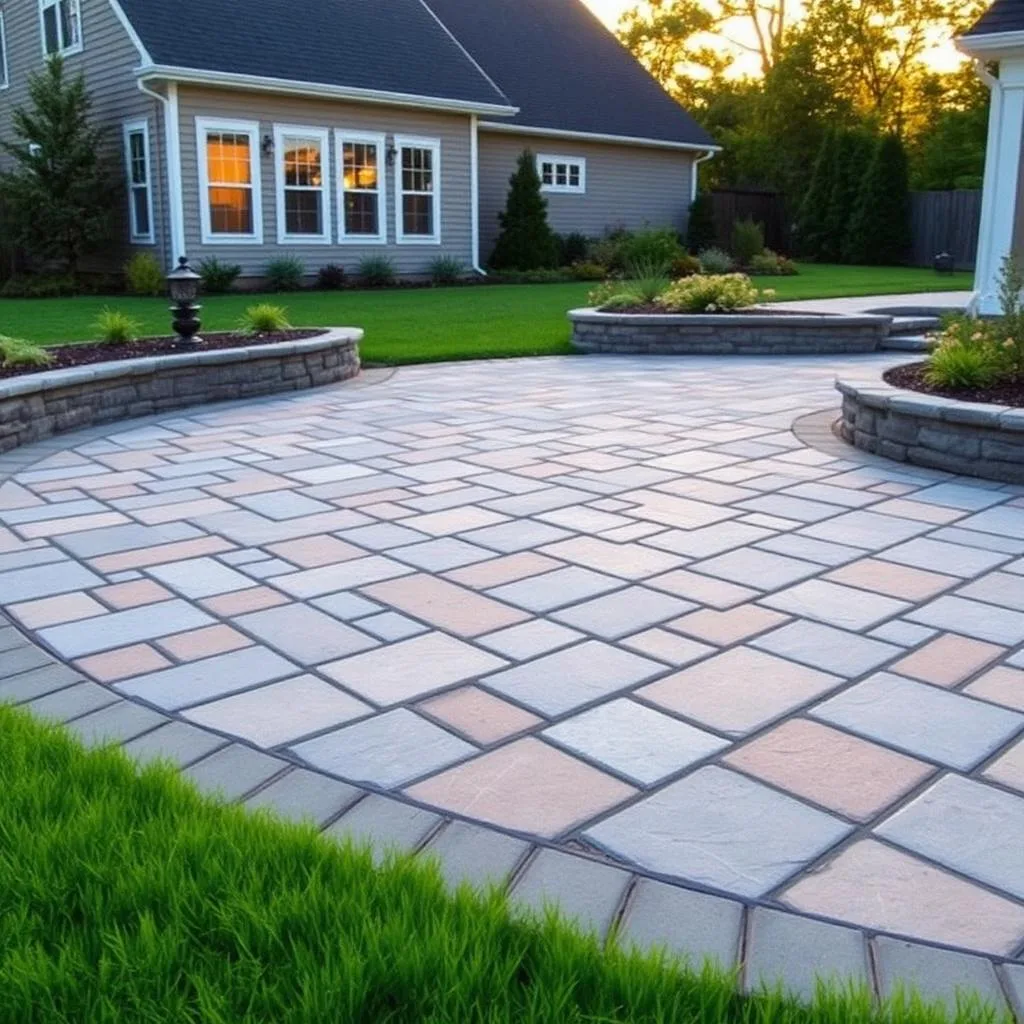
You paid for a paver patio three or four years ago. It looked perfect the day the crew left. Now the edge by the lawn has dropped an inch, a corner near the downspout has lifted, and weeds are coming up through the joints. This is the most common repair call we get across Walled Lake and Oakland County, and the cause is nearly always the same: the patio was built on a base that could not handle a Michigan winter.
What freeze-thaw does to a shallow base
Michigan sees 30 to 40 freeze-thaw cycles every winter. When water in the ground freezes, it expands and pushes everything above it up. When it thaws, everything drops back down, but never quite to the same place. A paver patio laid on two or three inches of sand over undisturbed clay has water sitting right under the pavers all winter. Every cycle lifts and drops them a little, and by spring the surface is wavy. That is heave.
Why the edges sink first
Edges fail when there is no edge restraint, or when the base stops right at the last paver. Without a proper restraint and a base that extends past the edge of the field, the outside pavers have nothing holding them, so they creep outward and drop. Once the edge opens, the joint sand washes out, the bedding sand follows, and the whole field starts to loosen.
Why the weeds show up
Weeds in paver joints are not coming up from below. Seeds blow in and germinate in loose joint sand. Polymeric sand, which hardens when it is wetted, locks the joints and keeps seeds and ants out. Plain sand does not. If your joints are growing weeds, they were almost certainly filled with regular sand or the polymeric sand was never activated properly.
How to build a paver patio that stays flat
- —Excavate deep. A patio needs six or more inches of compacted aggregate base. On Oakland County clay we often go deeper, and driveways get ten to twelve inches.
- —Compact in lifts. Base stone has to be compacted a few inches at a time with a plate compactor, not dumped in and leveled.
- —Pitch to drain. The surface should fall about a quarter inch per foot away from the house so water leaves instead of soaking under the pavers.
- —Extend the base past the edge and install edge restraint that actually restrains.
- —Lock the joints with polymeric sand, set and activated correctly.
Can a sunken patio be fixed?
One of the best things about pavers is that yes, often it can. If the base is sound and one area has settled, those pavers can be lifted, the bedding re-screeded, and the pavers reset with a nearly invisible repair. If the whole patio is wavy, the base was never right, and the honest fix is to pull the pavers, rebuild the base properly, and re-lay them. The pavers themselves are usually fine and can be reused.
The part nobody sees
Every paver patio we build in Walled Lake, Commerce, Novi, and across Oakland County gets a deep, compacted, well-drained base pitched so meltwater leaves. It is slower and it costs more than laying pavers on sand, and it is the whole reason our patios are still flat after the snow melts. Drainage is where we came from, and it is still where we start.
Have a paver patio that is sinking or heaving? We will tell you straight whether it can be reset or needs a new base, and give you a fixed price either way.