
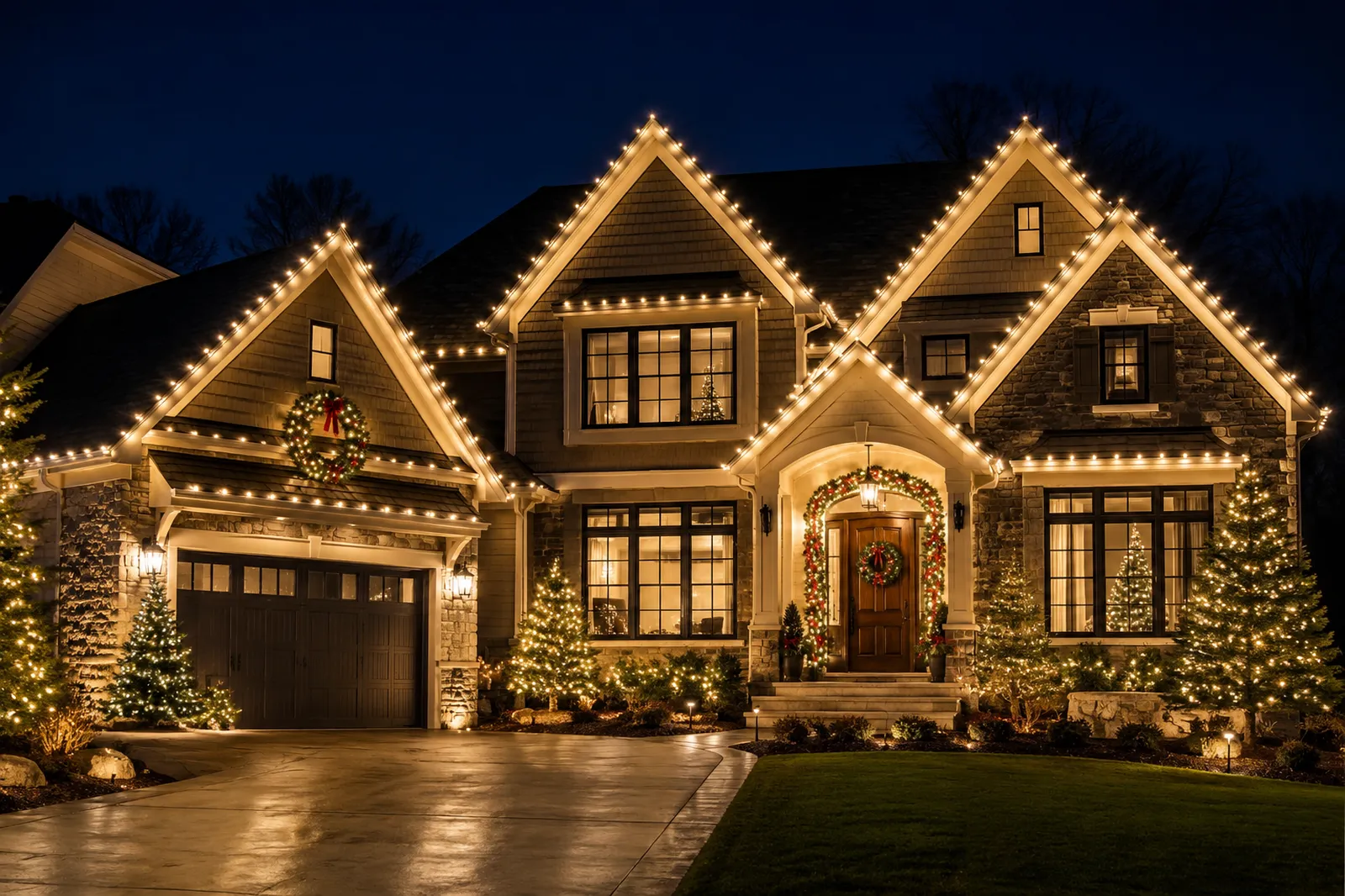
Every fall we hear the same question from homeowners in Novi, Commerce, and West Bloomfield: "Should we just put up permanent lights and be done with it?" It is a fair question. You pay for a holiday install every November, you pay again to take it down in January, and the whole thing happens on an icy roofline in the worst weather of the year. A system that stays up and turns on from your phone sounds like the obvious fix.
Sometimes it is. Sometimes it is not. Because our crew installs both seasonal holiday lighting and permanent architectural lighting, we do not have a reason to push you toward one. Here is how to figure out which one actually fits your house.
What permanent lighting actually is
Permanent lighting is a low-profile channel, or track, mounted along your roofline with LED lights set inside it. It is installed once and stays up all year. You control it from an app on your phone: warm white every evening for curb appeal, red and green in December, orange for Halloween, team colors on game day, or a slow color fade for a backyard party.
Traditional holiday lighting is the strands of C9 or mini lights clipped to your gutters and shingles each fall and taken down after the season. It is a seasonal service you buy each year.
Both can look great. The difference is in cost over time, how your home looks the other ten months, and how each handles a Michigan winter.
What each one costs
Seasonal installation. Nationally, Angi reports that professional holiday light installation for a typical two-story home runs about $350 to $800 a season, with larger homes running higher. In the Lakes Area, our own residential installs run from a few hundred dollars for a simple ranch roofline to around fifteen hundred dollars for a larger two-story home with tree and shrub wraps. That is a yearly cost.
Permanent lighting. This is a one-time investment. Industry cost guides put installed permanent systems at roughly $20 to $40 per linear foot, which works out to about $2,000 to $8,000 for most homes, depending on how much roofline you light and how complex it is. A Michigan lighting company's 2026 guide lands in the same place, at roughly $3,000 to $8,000 for most homes.
Those are general figures, not a quote. Your real number depends on your roofline, your peaks, and whether you want the front of the house only or the full perimeter.
The break-even math
Here is a simple way to think about it. Say your two-story home has about 180 feet of roofline you want lit.
- —If a seasonal install, takedown included, costs you about $600 a year, ten years of holiday lighting adds up to about $6,000.
- —If a permanent system on that same roofline runs about $25 a foot, the up-front cost is about $4,500.
In that example, permanent lighting pays for itself somewhere around year seven or eight, and every year after that is free apart from electricity and any service calls. If your seasonal bill runs higher, because you have a big roofline or lots of peaks, the break-even comes sooner. If you only light a small ranch roofline for a few hundred dollars a year, it may take much longer.
The math also leaves out a few things that are hard to price: no December ladder trips, no waiting on an installer's schedule, and lights you actually use for more than six weeks a year.
What changes in a Michigan winter
This is where our climate matters, and where the two options really differ.
Ice and snow on the roofline. Clipped holiday strands sit right where snow slides off and where ice builds along the gutters. Heavy ice can pull at clips and connections, and a January thaw can drive moisture into any connection that was not sealed well. That is why seasonal lights sometimes go dark halfway through the season.
A well-installed permanent track mounts to the fascia or trim board, not to the shingles, so nothing goes through the roof itself. It sits tight to the house and out of the way of most snow and ice. It still needs to be placed with care. If you rake snow off your roof or have ice dam problems, tell your installer so the track goes where a roof rake and falling ice will not hit it.
Gutters. If your gutters sag or pull away from the house, fix that first. Neither type of lighting should hang from a gutter that is already failing.
Your roof's age. If your roof or fascia will need replacing in the next few years, wait and do the lighting after. Permanent track can come down and go back up, but it is simpler and cheaper to install it on new trim.
How it looks the rest of the year
The most common worry we hear is: "Will I see the track all year?" A good permanent system uses a thin channel color-matched to your trim, so from the street it mostly disappears during the day. On most homes you would have to know it was there to notice it.
At night it becomes a feature. Many homeowners run a soft warm white every evening, which lights up the roofline much like landscape lighting does. That year-round use is a big part of what you are paying for. If you would only ever turn it on in December, the value is smaller.
When seasonal lighting is still the better choice
Permanent lighting is not right for every home. Stick with seasonal installation if:
- —You plan to move in the next few years. You probably won't get your money back before you sell, though the system does stay with the house.
- —You love the classic look. Big, old-fashioned C9 bulbs, wrapped trees, and garland on the porch are a different style from a clean roofline of LED points. Many people want that traditional look, and permanent lighting does not copy it exactly.
- —You only light a small section. If you light a short front roofline and one shrub, a seasonal install is hard to beat on cost.
- —Your HOA restricts it. Some subdivisions and condo associations have rules about exterior lighting or year-round fixtures. Check before you commit.
- —Your roof or trim needs work soon. Do that project first.
Plenty of homes do both: permanent lights on the roofline, and seasonal wraps on the trees and shrubs each year.
Questions to ask any installer
Whichever way you go, ask these before you sign:
- —Where will it mount, and will anything go through my roof or shingles? For permanent track, the answer should be the fascia or trim, with fastener points sealed.
- —What does the warranty cover, and for how long? Ask about the lights, the controller, and the installation separately.
- —Where will it plug in? Some homes need an outdoor outlet added in the right spot. Find out up front whether that is included or whether you will need an electrician.
- —What happens if a section stops working? Ask how service calls work and what they cost.
- —For seasonal lighting: are takedown and storage included? Some quotes cover only the install.
The bottom line
Permanent lighting makes the most sense for Oakland County homeowners who plan to stay put, light a good amount of roofline, and would actually use the lights year-round. For them, it usually pays for itself within several years and ends the yearly ladder routine for good. Seasonal installation is still the better fit for smaller displays, classic-look lovers, and anyone who might move soon.
Get a price for both, side by side
Michigan Outdoor Creations installs seasonal holiday lighting and app-controlled permanent lighting for homes and businesses across Walled Lake, Commerce, Novi, and the rest of Oakland County. Our CLIPA-certified crew uses no-damage mounting and cold-rated, sealed connections built for Michigan winters. We will come out for a free on-site measure and give you a fixed written price, so you can compare both options on your actual roofline before you decide.
Call 248-916-6012 or request your free measure online. Fall is our busiest season, so the earlier you call, the more install dates you have to choose from.
Common questions
How much do permanent Christmas lights cost in Michigan?
Most homes fall roughly between $2,000 and $8,000 installed, or about $20 to $40 per linear foot, depending on how much roofline is lit. Michigan Outdoor Creations gives a fixed written price after a free on-site measure.
Do permanent lights pay for themselves?
Often, yes, for homeowners who would otherwise pay for a seasonal install every year. On a typical two-story home, the break-even point is usually several years out. It comes sooner on large rooflines.
Can you see permanent lights during the day?
A quality system uses a thin track color-matched to your trim, so it is hard to notice from the street during the day.
Will permanent lighting damage my roof?
A proper installation mounts the track to the fascia or trim, not the shingles, with fastener points sealed, so nothing goes through the roof itself.
Do permanent lights hold up in Michigan winters?
A well-installed system sits tight to the house and out of the way of most snow and ice. Tell your installer if you rake your roof or have ice dam problems so the track is placed accordingly.