
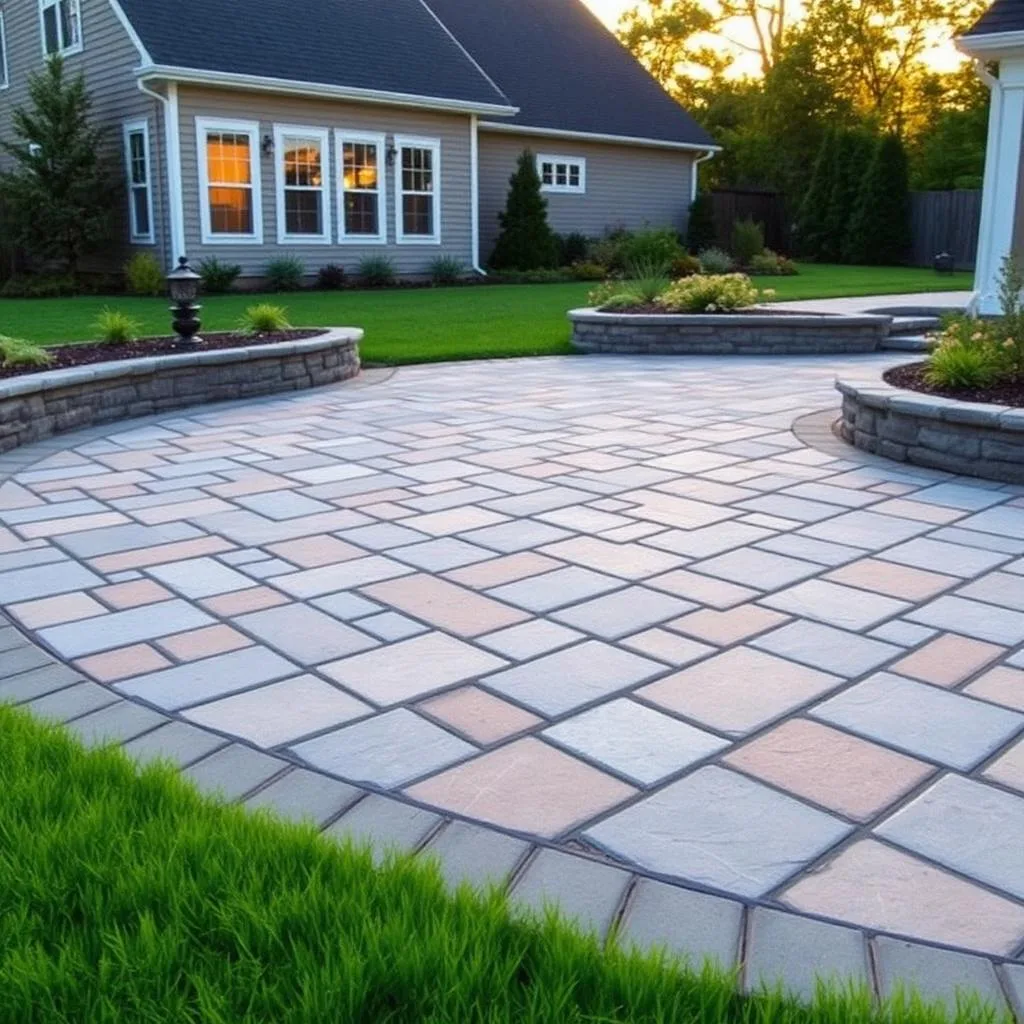
A driveway is the biggest piece of hardscape most homes have, and in Oakland County it takes more abuse than anything else outside: snowplows, rock salt, freeze-thaw cycles from November to April, and a couple of vehicles parked on it every day. When it is time to replace one, most homeowners are choosing between three materials: asphalt, poured concrete, and pavers. Each one makes sense for somebody. Here is how they compare, including how each one handles a Michigan winter.
One thing up front: we build paver driveways and concrete driveways, including stamped and decorative concrete. We do not install asphalt. We have still included it here, because it is the option most people are comparing against, and you deserve a straight comparison.
The quick comparison
- —Asphalt: lowest up-front cost, shortest lifespan, needs sealcoating every few years.
- —Poured concrete: moderate cost, long lifespan, very little routine upkeep, but cracks are repaired as a surface.
- —Pavers: highest up-front cost, long lifespan, and individual pieces can be lifted and reset if something settles.
What each one costs
National cost guides put installed asphalt driveways at roughly $5 to $12 per square foot and plain poured concrete at roughly $6 to $15 per square foot. Stamped and decorative concrete costs more than plain concrete. In the Lakes Area it generally runs about $12 to $22 per square foot, depending on the pattern, the number of colors, and the finish.
Pavers are the premium option. A Southeast Michigan cost guide puts paver driveways in Metro Detroit at roughly $18 to $50 per square foot installed, depending on whether you choose concrete pavers, clay brick, or natural stone. For an average two-car driveway, that difference adds up quickly.
These are general ranges, not quotes. The real number depends on the size of your driveway, how much old material has to come out, how much base has to go in, and what your soil is like.
How long each one lasts
Cost guides generally put asphalt at around 15 to 30 years with good maintenance, and concrete at around 30 to 40 years. Paver driveways built on a proper base can go longer. Because the surface is made of individual units, you can repair a paver driveway in sections instead of replacing it.
Those lifespans assume the driveway was built right. In Michigan, that comes down to one thing more than any other: the base underneath.
What a Michigan winter does to each one
Our winters are hard on driveways for the same reason they are hard on patios. Water gets into the ground or into the surface, freezes, expands, and pushes. Do that dozens of times a winter and weak spots show up fast.
Asphalt is flexible, which helps with small movement. But water that gets into cracks freezes and widens them, which is why asphalt needs regular crack filling and sealcoating, typically every three to five years. Without that upkeep, potholes and crumbling edges show up.
Poured concrete is rigid. It will crack. The goal is to control where it cracks. Properly spaced control joints give the slab a planned place to crack, in a straight line inside the joint instead of randomly across the middle. Sealing also helps, because it keeps water and de-icing salt from soaking into the surface and flaking it, which is called spalling. New concrete is most vulnerable in its first winter, so go easy on rock salt that first season.
Pavers handle freeze-thaw differently. The joints between them let the surface flex slightly as the ground moves. If one area settles, the pavers in that spot can be pulled up, the base re-leveled, and the same pavers put back. There is no patch that does not match.
The base is what decides everything
Whatever material you choose, the part you never see is what decides whether it lasts. A driveway carries the weight of vehicles, so it needs a much deeper base than a patio. On paver driveways we typically put down 10 to 12 inches of compacted aggregate base, installed and compacted in layers, compared with 6 inches or more under a patio. Concrete driveways get a thicker slab and heavier reinforcement than a patio slab, poured on a compacted base.
This is where cheap bids cut corners. A driveway that looks fine on day one but was built on a few inches of base will start to rut, sink, or crack within a few winters. When you compare quotes, ask each contractor how deep the base will be and how it will be compacted. If they cannot give you a straight answer, that tells you something.
Drainage matters too. A driveway should be pitched so water runs off toward the street or a drain, not back toward your garage or foundation. Water that sits on a driveway freezes into ice and finds its way into every crack and joint.
Snowplows, shovels, and salt
If you have a plow service, tell your contractor. Plow blades can catch the edge of pavers or chip the edges of concrete. Many plow operators can use a rubber blade edge or raise the blade slightly. On paver driveways, solid edge restraint keeps the border tight so the blade has nothing to grab.
For de-icing, use a product designed for concrete and pavers and use as little as you need. Shoveling or blowing snow before it gets packed down does more than any de-icer.
Upkeep over the years
- —Asphalt: crack filling as needed and sealcoating every few years.
- —Concrete: occasional cleaning and resealing every few years, especially on stamped or colored concrete, to protect the color and the surface.
- —Pavers: occasional cleaning, topping up the joint sand if it washes out, and optional sealing. The polymeric joint sand we use locks the joints and helps keep weeds out.
Permits and your city
Many Oakland County cities and townships require a permit to replace a driveway, especially the apron where the driveway meets the road, because that part sits in the public right-of-way. Some subdivisions also have HOA rules about driveway materials or colors. Check with your city or township and your HOA before you commit. A contractor who works in your community regularly should know the process.
So which one should you choose?
Choose asphalt if the lowest up-front cost matters most and you are comfortable with regular sealcoating and a shorter lifespan.
Choose poured or stamped concrete if you want a long-lasting driveway with little routine upkeep, and you like the idea of a decorative finish that looks like stone or brick for less than pavers cost.
Choose pavers if you want the most upscale look, plan to stay in the home for a long time, and like knowing that settling or damage can be fixed one section at a time.
Plenty of homeowners mix materials too, such as a concrete driveway with a paver border or a paver apron at the front walk. That can give you some of the look of pavers at a lower cost.
Get both options priced for your driveway
Michigan Outdoor Creations builds paver driveways and poured and stamped concrete driveways across Walled Lake, Commerce, Novi, and the rest of Oakland County. Every driveway goes down on a deep, compacted base and is pitched to drain. We will walk your driveway with you, check the grade and the soil, and give you a fixed written price, so you can compare pavers and concrete side by side for your home.
Call 248-916-6012 or request a free on-site estimate.
Common questions
How much does a paver driveway cost in Oakland County?
Southeast Michigan cost guides put paver driveways at roughly $18 to $50 per square foot installed, depending on the paver type and how much base is needed. Michigan Outdoor Creations gives a fixed written price after an on-site look.
Which driveway lasts longest in Michigan?
Built on a proper base, concrete and paver driveways generally outlast asphalt. Pavers have the added advantage that damaged or settled sections can be lifted and reset.
How deep should the base be under a paver driveway?
Much deeper than a patio. Michigan Outdoor Creations typically installs 10 to 12 inches of compacted aggregate base under paver driveways because they carry vehicle loads through freeze-thaw cycles.
Do you install asphalt driveways?
No. Michigan Outdoor Creations builds paver driveways and poured, stamped, and decorative concrete driveways.
Can I use rock salt on a new concrete driveway?
Go easy on it, especially in the first winter, when new concrete is most vulnerable. Use a de-icer made for concrete, use as little as needed, and clear snow before it gets packed down.