
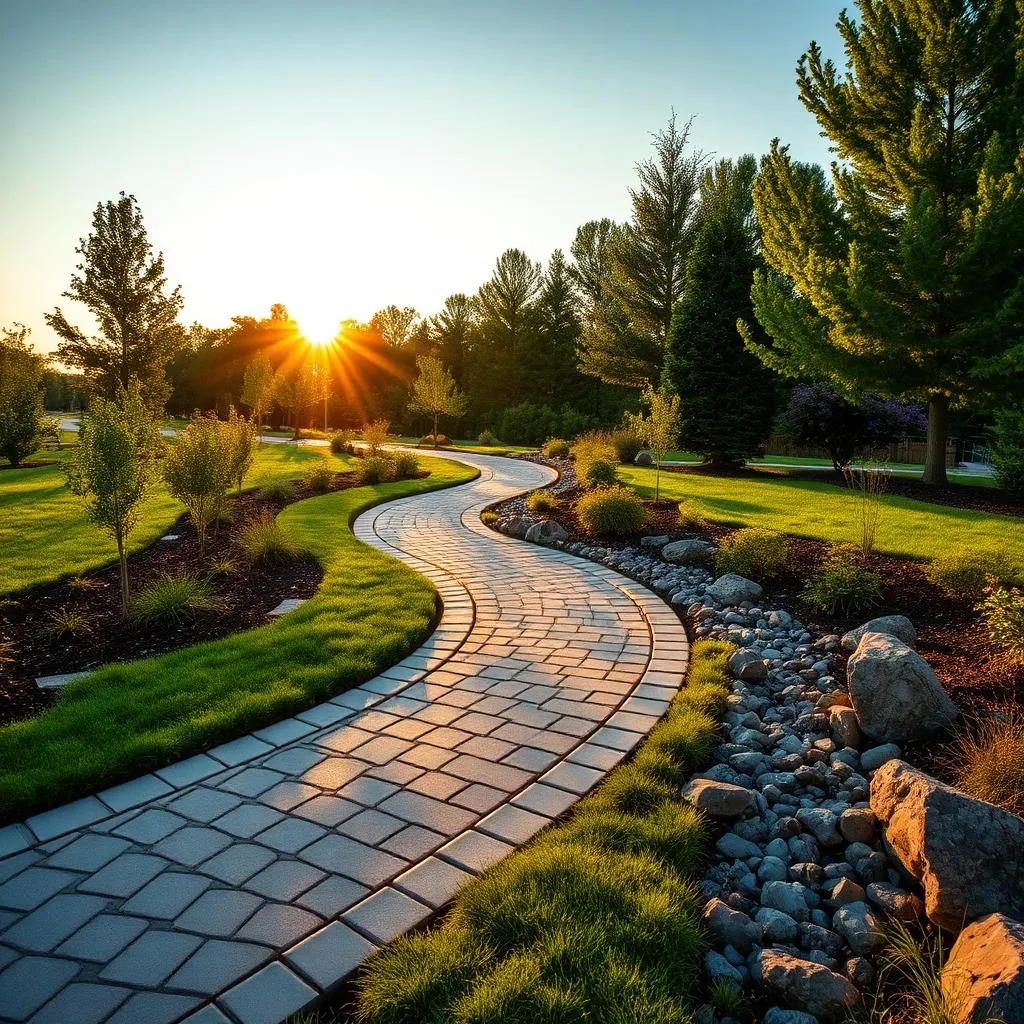
Homeowners in Oakland County ask us this one every time stamped concrete comes up: will it crack? The honest answer is that all concrete moves, and every slab will crack somewhere eventually. The real question is whether it cracks where it was designed to, hidden in a control joint, or whether it cracks randomly across your patio and starts flaking apart. Here is what decides that in a Michigan winter.
Cracking versus spalling: two different problems
A crack is the slab breaking because it moved. Spalling is the surface flaking or pitting off in patches, and it is the failure that ruins the look of stamped concrete. Spalling happens when water gets into the top of the slab, freezes, expands, and pops the surface off. Cracking is mostly about the base. Spalling is mostly about water, sealer, and salt.
What prevents random cracking
- —A compacted aggregate base. Concrete poured over loose or wet clay settles unevenly and cracks. The base has to be compacted and dry.
- —Correct thickness and reinforcement. Patios get a proper slab depth with fiber or wire reinforcement. Driveways get thicker slabs and heavier steel.
- —Control joints in the right places. Joints are cut or tooled to tell the slab where to crack. Spaced correctly, the cracks happen in the joint and you never see them.
- —Pitch. A slab graded to drain does not hold water on its surface or under its edges.
What prevents spalling
Sealer. A stamped patio needs a freeze-thaw-rated sealer applied after the pour and reapplied roughly every two to three years in Michigan. The sealer keeps water out of the surface so there is nothing to freeze and pop. It also protects the color. If a stamped patio in Novi or West Bloomfield looks chalky and faded and is starting to pit, the sealer has worn off and water is getting in.
The de-icer problem
This is the one that surprises people. Rock salt and many ice melt products are hard on concrete, and they are brutal on concrete in its first winter before it has fully cured. Salt draws more water into the surface and increases the number of freeze-thaw cycles the slab goes through. On a new stamped patio, skip the de-icer entirely the first winter and use sand for traction. After that, use a concrete-safe product sparingly and keep the sealer fresh.
Stamped concrete versus pavers, again
Pavers flex with the ground and can be lifted and reset, so they shrug off freeze-thaw. Stamped concrete is rigid and depends on base prep, joints, and sealer to manage it. Stamped concrete usually costs less to install, roughly $12 to $22 per square foot in the Lakes Area, and can look great for decades when it is built and maintained right. If you would rather not think about resealing, pavers may be the better fit. We build both and will tell you which one suits your lot and your habits.
Considering a stamped concrete patio, walkway, or driveway in Walled Lake, Commerce, or anywhere in Oakland County? We pour on a compacted base, cut the joints where they belong, seal it, and pitch it so water leaves. Then we tell you exactly how to care for it.