
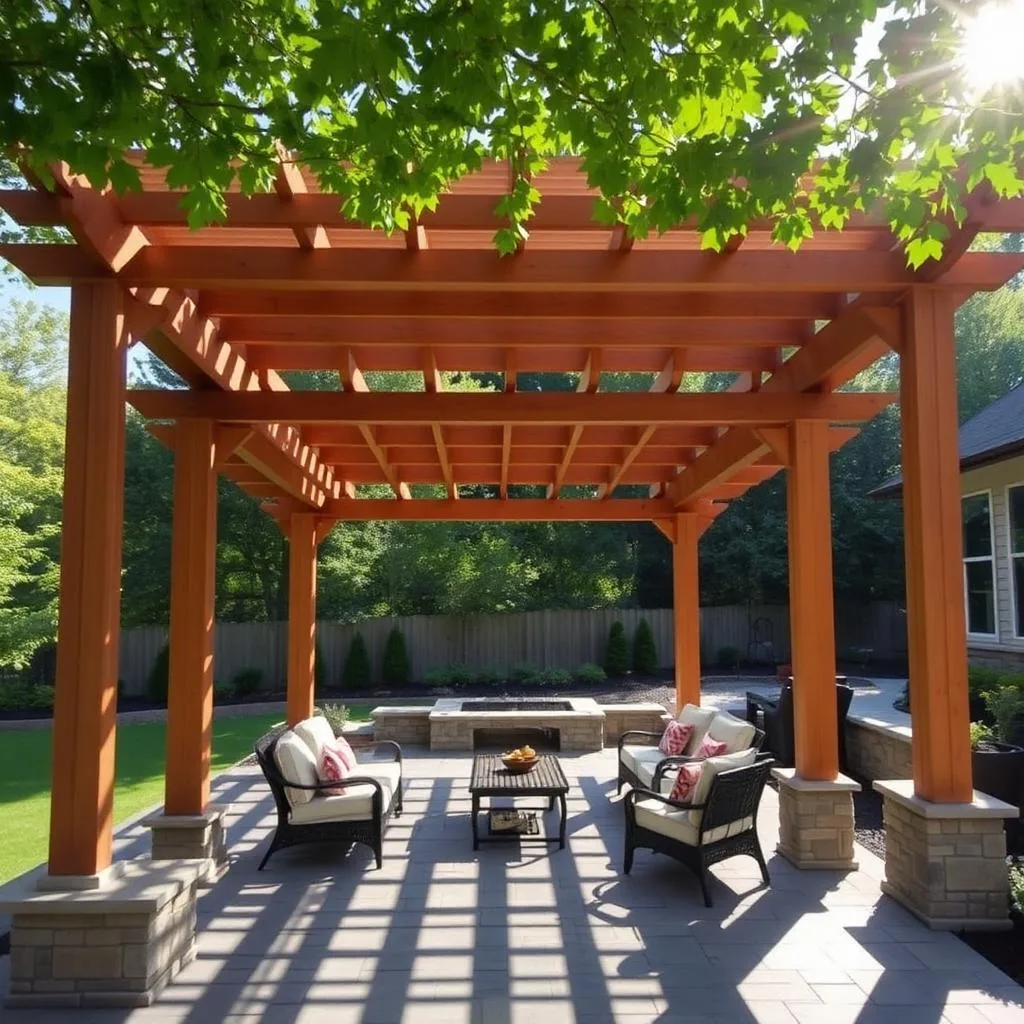
A backyard that turns into a pond after every storm and stays soggy for days is one of the most common complaints we hear from homeowners in Farmington Hills, Wixom, Commerce, and across Oakland County. It kills grass, breeds mosquitoes, ruins any patio you put on top of it, and, worst of all, often means water is heading toward your foundation. Here is why it happens here and what actually fixes it.
Why Oakland County yards hold water
Most of the county sits on heavy clay left behind by glaciers. Clay drains slowly, so once the top few inches are saturated, water simply sits. On top of that, a lot of yards were graded flat or, worse, graded toward the house. Newer subdivisions in Wixom and New Hudson often have freshly disturbed clay that has settled unevenly. Older neighborhoods in Farmington Hills have decades-old grading that no longer sheds water the way it once did. Add downspouts dumping right at the foundation and a low spot near the fence, and you have a pond.
Start with the cheap fixes
- —Extend downspouts. Six feet of extension pipe or a buried downspout drain moves a lot of water away from the house for very little money.
- —Look at the neighbors. Water flows downhill. If the lot next door pitches toward yours, that has to be part of the plan.
- —Check for compaction. Yards that were driven on during construction or used as a play area can be so compacted that water cannot get in at all.
Regrading: the fix most yards actually need
The most reliable cure for standing water is making the ground go somewhere. Regrading means reshaping the yard so it falls gently away from the house, usually a few inches over the first ten feet, and toward a place where water can safely leave: a swale, a drain, the street, or a low corner designed to take it. On a lot of Oakland County lots, regrading alone solves the problem. It is also the first thing we do before any patio, wall, or planting goes in, because building on top of a drainage problem just buries it.
French drains and swales
When grading alone is not enough, a French drain gives water a highway out. It is a trench with perforated pipe wrapped in clean stone and fabric, sloped to carry water to an outlet. A swale is a shallow, gently sloped channel in the lawn that does the same job on the surface and can be planted so it disappears. On lake lots in Commerce, White Lake, and Waterford, where the water table is already high, these systems are often the difference between a usable yard and a swamp.
When a retaining wall is the answer
On sloped lots in Clarkston, Northville, and Milford, water pooling at the bottom of a hill is a grade problem, not just a drainage problem. A properly drained retaining wall terraces the slope, catches water behind it in drain tile, and moves it where it belongs. The wall and the water management are designed together.
Do not build a patio on a wet yard
We get asked to put a paver patio over a spot that floods, and the answer is always the same: fix the water first. Pavers set over saturated clay heave the first winter. Concrete poured over it cracks. A patio on a drained, graded base lasts decades. A patio on a puddle lasts until March.
Michigan Outdoor Creations grew out of a drainage company, and moving water is still the first thing we solve on every job. If your yard in Farmington Hills, Wixom, Commerce, or anywhere in Oakland County holds water, we will walk it, find where the water wants to go, and build a plan that gets it there.